Towing is not as easy as fastening a trailer and hitting the road, and, in fact, one must have an appropriate setup to be safe on the road. You are likely to have a hitch choosing the wrong hitch, which will lead to inefficient handling, strain, and even serious damage to your car. This is one of the reasons why you should be familiar with the different types of hitch receivers when you are about to hit the road, towing anything, whether it be a small trailer, a bike rack, or a heavy load.
All types of trailer hitches are not the same. Both hitch receivers are designed with a purpose, size, and towing capability. Choosing the improper towing hitch may cause stability to be lost on your vehicle, diminish safety, and cause long-term problems in your suspension or alignment. This is particularly necessary for truck and SUV owners who need a steady towing configuration.
At Gresham 4 Wheel Drive, one of the things that we can assist our drivers with is selecting the appropriate hitch receiver. Most individuals mix up the kinds of hitch receivers or even choose the wrong one, according to their vehicles. We will provide an easy-to-understand explanation of the different types of hitch receivers in this guide so that you can choose the appropriate receiver to ensure towing is safe and easy.
What Is a Hitch Receiver
A hitch receiver is a solid-metal device attached to the rear side of a vehicle, and in some cases the front, that enables you to complete a tow apparatus such as trailers, bike racks, or cargo carriers. It serves as the primary point of connection between your vehicle and anything you wish to tow, and so is a key component of any towing system.
Hitch receiver. When one is attempting to locate the kind of trailer hitch or when he or she is seeking information on the kind of towing hitch, they mean the many categories of hitch receivers that are used for specific weights, as well as actual use. All receivers are restricted in set towing capacity and tongue weight limit, and this restricts their maximum safe load to a certain load. The right choice will guarantee good driving and vehicle performance.
In Gresham 4 Wheel Drive, we assist drivers in selecting the various types of hitch receivers to enable them to know the type of receiver to match their car. The selected and installed hitch receiver enhances safety, stability, and towing control, particularly in trucks and SUVs when they work or drive off-road.
Why It Matters for Your Vehicle
The hitch type that you use matters as it will make a difference in terms of safety and towing issues of your vehicle. Correct installation will ensure your trailer is in place, easy handling, and the load on your frame and suspension is minimized. The absence of the proper match may turn towing rather unsafe.
Various types of towing hitches have varying weight capacities, and each vehicle has a safe towing capacity. In case the hitch receiver is inappropriate to manage the weight, it may result in swaying, ineffective braking, and even long-term destruction. This is why it is so important to know what kind of hitch receivers to use before towing something.
At Gresham 4 wheel drive, we assist drivers in selecting the types of hitch receivers to buy, depending on their vehicles and their requirements. Properly made selection benefits not only the safety, but it will also enable you to experience more comfortable and confident towing each time.
Also Know About: Pintle Hitch vs Ball Hitch: Best Option for Heavy Loads?
5 Different Types of Hitch Receivers
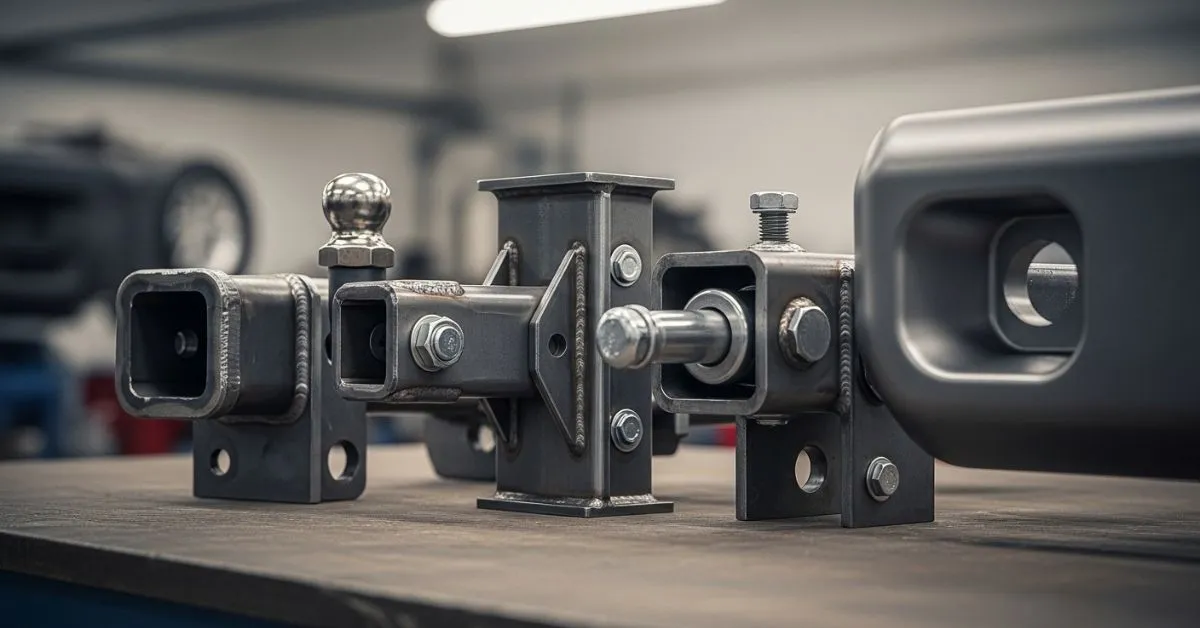
Not every hitch setup is equally good when it comes to towing. The hitch receiver comes in different types depending on the place of installation and application in fulfilling various towing requirements. Both designs have their advantages in terms of safety, control, and convenience. Knowing these choices will give you a way of selecting the appropriate towing setup to apply to your car.
1. Rear-Mount Receiver Hitches
The most common receiver hitches are rear-mount receiver hitches, applied to cars, SUVs, and trucks alike. They are fitted towards the rear of the car and are primarily applied in towing trailers, campers, and cargo carriers. The hitches are highly supportive and can fit most of the daily towing requirements. They can also be connected and disconnected when necessary.
2. Front-Mount Receiver Hitches
The front-mount receiver hitch is mounted at the front of the vehicle, which provides more control in narrow areas. They can be applied to place trailers, boats, or other vehicles, which are more visible. These hitches are particularly handy in off-road driving and in work vehicles. They are useful in enhancing situations where accuracy is required.
3. Bumper Receiver Hitches
Bumper receiver hitches are simply installed upon a vehicle bumper or constructed onto the bumper. When it comes to light towing applications such as small trailers, bike racks, cargo carriers, etc., they tend to be employed. These hitches are not heavy-duty, and hence they are only applied in simple everyday duties. They are not complex, small, and easily fit in most vehicles.
4. Adjustable Receiver Hitches
Adjustable receiver hitches are flexible; they can be pulled up or down in accordance with towing requirements. They come in handy when towing the various kinds of trailers that are of different heights and weights. This type assists in a better balance and level towing performance. They are favored by many truck owners due to their flexibility to meet the ever-changing load demands.
5. Universal Receiver Hitches
Universal receiver hitches are designed to suit a broad spectrum of cars and thus are a preferred choice when something can be used universally. These can be customized or tailored in accordance with alternative towing requirements. Although these are convenient, they might not have as much accuracy as vehicle-specific hitches. Nonetheless, they are a viable alternative that can be used for light to moderate towing requirements.
Also Explore: Trailer Hitch vs Receiver Hitch: Shocking Differences Revealed
How to Choose the Right Hitch Receiver for Your Needs
The selection of the hitch receiver is not the process of selecting one that comes across your path and hoping that you can tie it down to your car, your towing requirements, and the frequency of your usage. A proper decision enhances security, stability, and comfort on the road. A few points will enable you to pick the most appropriate one regarding your setup.
- Know Your Vehicle’s Towing Capacity: Each of the vehicles has a certain towing capacity as defined by the manufacturer. This will inform you of the weight capacity of your car, SUV, or truck. Missing this limit may ruin your engine, your suspension, and your braking system in the long run.
- Understand What You Will Tow: You should be aware of what you are proposing to tow, which is either the trailer, boat, or cargo carrier. A variety of loads have varied hitch strengths and need varied receiver sizes. The smaller setups can be used with light loads, whereas the heavy loads require more robust hitch options.
- Select the Appropriate Hitch Class and Size: Hitch receivers are available in various classes and sizes, such as 1.25-inch and 2-inch. The correct classification will rely on your pulling weight and the type of vehicle. Choosing the right size guarantees a safe fit of the size and ensures safer towing.
- Overlooking Proper Fit and Size: When you do regular towing, you require a more robust hitch receiver. Users can have the lighter options, which are easily installed and uninstalled. Better stability and long-term reliability are also needed for frequent towing.
- Attempting DIY Installation Without Experience: It may be too confusing at times to select the appropriate hitch all by yourself. Consulting the professionals will help you choose the safest and most appropriate solution. At Gresham 4 Wheel Drive, we assist customers in choosing and installing the appropriate hitch for their usage.
Explore More: Cost to Install a Tow Hitch: Ultimate Price Guide
Common Mistakes People Make When Choosing Hitch Receivers
Hitch receiver selection may be a complex task since most drivers make errors that may cause unsafe towing and damage to the vehicle. Such attacks are normally committed by individuals who neglect weight restrictions, automobile necessities, or improper installation. Knowing these pitfalls will enable you to make a wiser and safer choice.
- Neglecting Vehicle Towing Capacity: A good number of individuals will fit up a hitch without consulting the towing capacity of the vehicle. This will cause overloading; this exerts severe pressure on the engine and brakes. Information: Do not exceed the weight of your vehicle, which can be towed safely.
- Incorrectly Selecting the Hitch Class: Other drivers select the hitch receiver that is either too weak or too strong that they require. This causes an uneven balance and can decrease the towing efficiency. The classes of hits are intended to be used under a particular weight range; thus, it is important to make the correct choice.
- Failing to Take into Account the Type of Load: It is also common to forget that various loads have different towing arrangements. The hitch is subjected to various pressures on a trailer, boat, or cargo carrier. A lack of attention to this may result in poor stability and unsafe driving.
- Ignoring Fitting Properly and Size: Since improper hitching commitment is an ordinary error, common mistakes include mismatching 1.25-inch hitching and 2-inch hitching, and utilizing the inappropriate hitching attachment. This may lead to loose connections or improper towing performance. The correct fit results in a stable fit and minimizes movement driving.
- Attempt to install a hitch receiver by DIY: A significant number of drivers attempt to do it without the appropriate tools and knowledge. Misalignment and risk of safety can occur due to improper fitting. Installation by professionals will make it all fit and in the right place.
Also Explore: Class 2 vs Class 3 Hitch: The Ultimate Showdown
Why Professional Trust Gresham 4 Wheel Drive for Hitch Receiver Installation
The correct installation of the hitch became a key feature of safe towing, as one will affect stability and braking, as well as performance overall. The vast majority are not interested in DIY work and are more likely to employ the services of a professional whenever performing different types of Hitch Receivers and towing options that require the proper installation.
We install the hitch receivers at Gresham 4 Wheel Drive with due consideration of the alignment to the vehicle, the balance of the vehicle, and the towing capacity. Our team knows the functionality of various vehicles and suspension systems, such as lifted trucks and off-road construction; hence, all are installed most safely and properly to achieve smooth towing action.
We also advise customers on the appropriate sizes and types of trailer hitches to use, depending on their customers’ needs. We simplify and understand the weight limits for the right installation. This is why lots of motorists refer to the 4 Wheel Drive in Gresham to get a safe, strong, and reliable hitch installation.
Conclusion
It is crucial to know the various types of Hitch Receivers in order to have safe, smooth, and stress-free towing. Rear and front mounted, adjustable and universal, each of the types of hitch serves a purpose, has its own strength, and application. Whether it is an SUV or a car, the kind of cargo one is towing, and the frequency of towing, the choice of the correct one will vary.
Identifying the appropriate forms of trailer hitch and installing them into the towing capacity of your car, you will increase the safety, control, and overall driving experience. It also helps in protecting your engine, suspension, and frame against unnecessary pressure. And that is why it is better to make a choice than to guess or to utilize the improper arrangement.
At Gresham 4 Wheel Drive, we assist drivers in selecting and fitting the correct hitch receiver for their specific requirements. Whether it’s in driving around, off-road use, or heavy-duty, we want to ensure that whatever you have is strong, reliable, and on the road when you need it.