Have you ever noticed how your car is pulling slowly towards one side, though you are not turning it? Or did you see the tyres wearing out on the side without figuring out why they are? These trivial signs usually compel motorists to pause and consider: Is it worth the money and time to get your wheels aligned, or would it be possible to do it later?
One of such services that many people do not give much attention to is wheel alignment, since the car continues to operate. However, when you notice that your steering wheel is not centred or your car does not straighten, then normally the wheels are not aligned. In the long run, this may shorten the life cycle of tyres and also the safety of your vehicle, particularly in the event of daily commuting or use of bad roads.
Normal wear, speed bumps and potholes gradually nudge out of place wheels. The recent auto service data showed that improper alignment could reduce tyre life by 25 per cent, and slightly accelerate the consumption of fuel. This is why it can be useful to learn the alignment at the beginning of the process in order to prevent larger troubles in the future. We will make things simple and plain in the following parts so that you can make a choice whether or not wheel alignment is worth your money.
What Is Four-Wheel Alignment
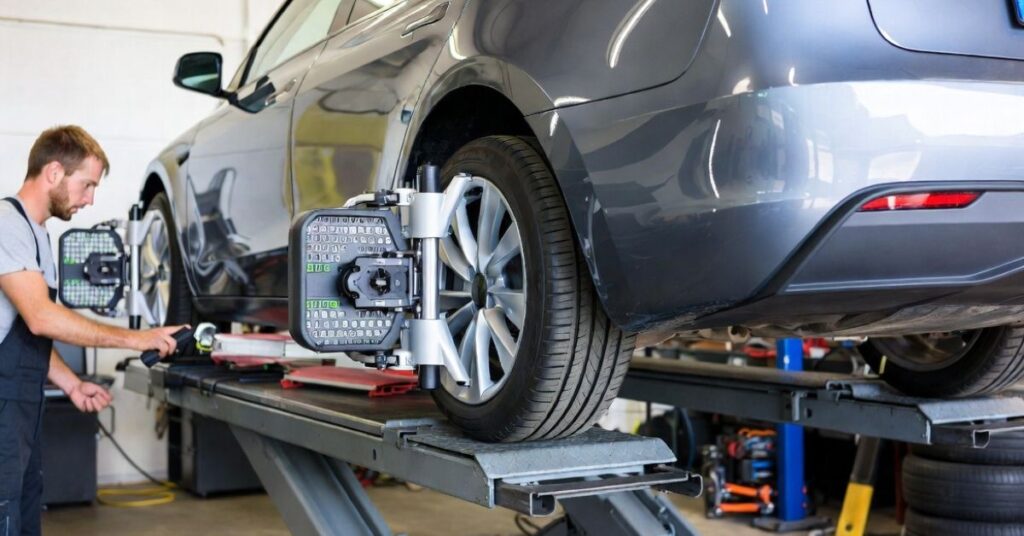
A four-wheel alignment service serves to align all four wheels of your vehicle so that they are facing the correct direction and are at the correct angles. Everything is adjusted correctly, and your car will move straight, your steering mechanism will suit you, and your tyres will be even.
Normal driving slowly causes the wheels to be out of position over time. When you hit a pothole, curb or uneven roads, these can alter the wheel angles without your awareness. Alignment involves three angles referred to as camber, caster and toe that determine the way each tyre contacts the road and responds to the steering.
In contrast to the older cars, modern cars, trucks, and SUVs are made in a way that all four wheels are inspected simultaneously. A minor problem with the back wheels will influence the steering and stability of the front. That is why four-wheel alignment can be regarded as an important routine maintenance, rather than a post-damage repair.
The alignment of your wheels may not be a major issue, but it is something that, in the background, influences a number of components in your vehicle whenever you drive. When the wheels are properly aligned, it all works out in unison. When they are not, minor issues begin to manifest themselves and gradually acquire the proportions of larger ones. This is why alignment is important indeed:
- Improves road safety: With the properly aligned wheels, your car will go straight on the road. The car has the advantage of not pulling on either side with properly set wheels, thus more control and safe handling, particularly when travelling at a higher speed.
- Prevents lopsided wear in tyres: The misaligned tyres wear out in a lopsided manner, with one side of the tyre wearing faster than the other. This can reduce the life of tyres by a quarter, and ensure replacement of tyres is a must at a very high price.
- Keeps the steering straight: Good steering keeps the steering straight. You will not have the vibrations and constant correction on the road, thus making the trips more comfortable.
- Discusses the steering and suspension elements: The misalignment leads to an extra burden on the suspension parts. This can, in the long run, cause components like tie rods and bushings to be damaged, making them more expensive to repair.
- Enhances increased fuel economy: With aligned wheels, the car will roll without additional friction. This aids in minimising the wastage of fuel during dragging tyres.
These arguments indicate the reasons why wheel alignment is not only about comfort but also about saving money, saving lives and maintenance of vehicles in the long run. Maintaining a good wheel alignment is a low-cost measure of ensuring your vehicle is safe, comfortable, and you do not spend more money to repair it in the future.
Why Your Wheel Alignment Is Important
Wheel alignment will have an impact on you when you are using your car on a daily basis. Minor misalignments accumulate fast when driving around in everyday life, particularly in urban roads that are full of bumps and potholes. That is why most people often end up asking themselves a question: Is wheel alignment worth it as an ordinary thing to use?
The benefits are readily observable when this has been aligned properly. It is not merely a matter of addressing an issue and making daily driving a little easier and more trustworthy. This is the actual advantage of the day-to-day users:
- Easy and comfortable ride: Your car stays straight on without off-course corrections. This causes driving to be less stressful and tiring, particularly in traffic or long commutes.
- Higher control and management: With correctly turned wheels, your car will react better to turns and braking. This improves the control during sudden stops, curves and lane changes, in which the vehicle becomes safer and more predictable.
- Tyres that last longer: When the tyres are not in the proper position, they wear unequally, and the inside or outer parts usually wear out more frequently. Even distribution of the wear of tyres is also achieved by proper positioning, and it allows them to last their useful life instead of being disposed of earlier than they would normally.
- Less stress during driving: A car that is not leaning on one side is not as stressful as one that is leaning on one side. One does not have to struggle with the steering wheel, and it is not as mentally and physically straining during the daily trips.
- Enhanced fuel economy: According to the automotive service data, ill-fitting wheels heighten rolling resistance, which can slightly decrease the fuel economy. Correct alignment will assist in making your vehicle roll without consuming as much fuel in the end.
To ordinary motorists, wheel alignment is not a service, but rather a health service. The benefits are not that huge, but when combined, they make daily driving comfortable, safer, and less expensive.
Read More About: Wheel Alignment vs Steering Alignment: Avoid Costly Repairs
Is Wheel Alignment Worth It for Daily Driving? The Real Benefits
Wheel alignment will have an impact on you when you are using your car on a daily basis. Minor misalignments accumulate fast when driving around in everyday life, particularly in urban roads that are full of bumps and potholes. That is why most people often end up asking themselves a question: Is wheel alignment worth it as an ordinary thing to use?
The benefits are readily observable when this has been aligned properly. It is not merely a matter of addressing an issue and making daily driving a little easier and more trustworthy. This is the actual advantage of the day-to-day users:
- Easy and comfortable ride: Your car stays straight on without off-course corrections. This causes driving to be less stressful and tiring, particularly in traffic or long commutes.
- Higher control and management: With correctly turned wheels, your car will react better to turns and braking. This increases the control in case of a sudden stop, lane change, and curves, and makes the vehicle feel more stable and predictable.
- Long life of tyres: The tyres will also be worn unevenly when the wheels are not turned properly, and the inner or outer part will tend to wear away more easily. Proper positioning ensures tyres wear at even rates, thus being able to achieve their maximum life span rather than having to be replaced soon.
- Reduced stressful situations behind the wheel: When a car does not pull to one side, then it feels more relaxed to drive. You do not need to wrestle with the steering wheel; this causes less mental and physical stress when you are making daily journeys.
- Better fuel efficiency: According to the data on automotive service, poorly aligned wheels add to rolling resistance, slightly decreasing the efficiency of fuel. Correct alignment causes your car to roll more freely, which will save you a lot of fuel in the long run.
The ordinary drivers do not have to mend their wheels; they need preventive maintenance. Individually, these benefits can be defined as minor, but they will help make the daily driving experience more comfortable, safe, and cheaper.
Explore More About: Difference Between Wheel Alignment and Wheel Balancing Guide
Common Wheel Misalignment Symptoms

Misalignment of wheels does not normally occur immediately. It begins at a slow pace, and most of the drivers continue driving without noticing that there is something wrong. The thing is that the longer the misalignment goes unnoticed, the greater damage it can do to your tyres and suspension. Being aware of the symptoms in their early stages assists you in correcting the situation by fixing it, rather than incurring a costly repair.
The most common signs of a mismatched set of wheels are listed below:
- Pulling to the side of the vehicle: When you are straight on a flat road, it is a good sign that the car is having some problems with the alignment when the car pulls to the right or left. This may cause driving to be exhausting and decrease control, particularly at high velocities.
- Lop-sided or high-speed tyre wear: The lop-sided tyre wear is one of the most apparent indications. You can observe that the inner or outer edges have been wearing out more than the other parts of the tree. This kills the life of tyres, and in most cases, its impact is realised at an opportune time.
- Steering wheel off centre: When driving straight, the steering wheel is not centred; in many cases, it is a pointer to the fact that the wheels are not centred. This may be minor at first, but it affects the overall balance of the vehicle.
- Vibration on the steering wheel: The vibration at the steering wheel can be attributed to a lack of alignment, especially on the highways. This is what renders the ride uncomfortable.
- Poor straight line stability: When your car does not feel steady, or even when the car feels like it is shaking, then it may be a case with the alignment. The car can seem as if it is drifting rather than maintaining a straight line.
Nevertheless, the auto maintenance reports indicate that the majority of the alignment issues are not a result of major car accidents but rather of daily driving. Early detection of these symptoms can save your tyres, your suspension, and your vehicle from driving on its way.
What Does Professional Wheel Alignment Include?
Professional wheel alignment is a cautious exercise aimed at ensuring that your car travels in a straight line, is steady, and that it does not burn tyres easily. It is not a rapid adaptation or a simple test. A full wheel and suspension check is a good alignment service that examines the whole wheel and suspension system to ensure that all the parts are working as intended.
This is what a trained wheel balancing normally involves:
- Full inspection of the vehicle: The inspection begins with inspection of the wheels, tyres, and suspension. Technicians examine worn or damaged parts that may have an influence on the result of the alignment.
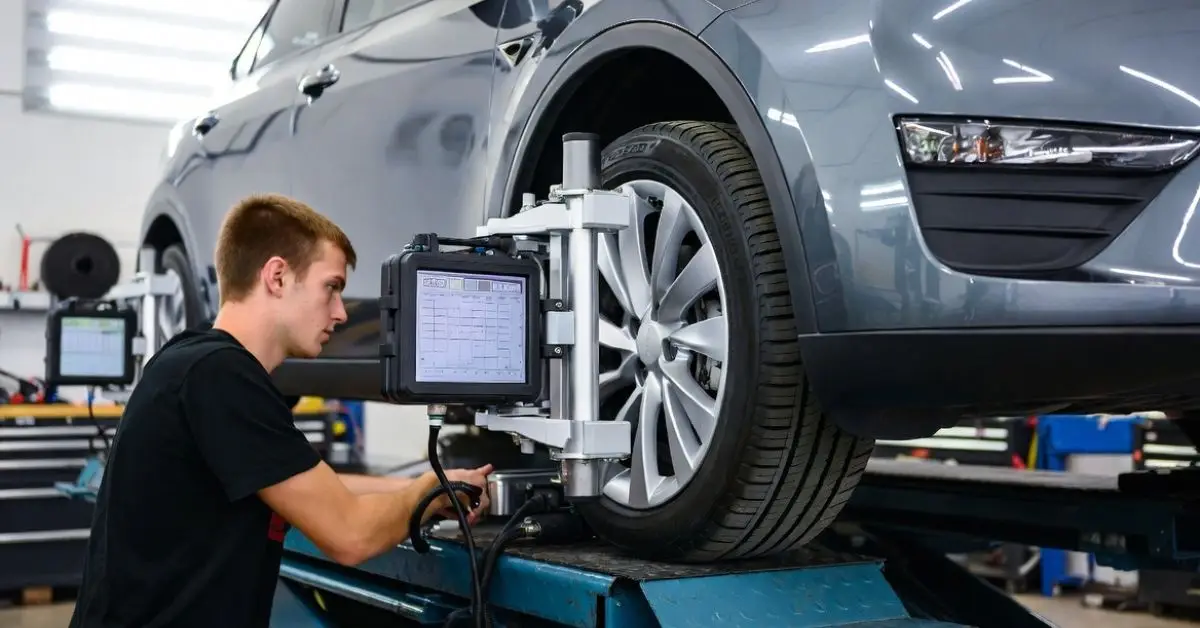
- Computerised alignment check: The new alignment systems have more sophisticated sensors to gauge the position of each wheel. This will enable accurate readings relative to factory specifications as well as detect minor misalignments.
- Alignment changes: The major alignment angles are changed, and they include camber, caster, and toe, which are corrected and returned to their natural position. Such a step is the one that assists in rebuilding straight driving and even tyre contact.
- Steering and suspension test: A skilled alignment technician also examines steering and suspension components to make sure that they are capable of maintaining the adjustments appropriately. Alignment might not be permanent in case the parts are worn.
- Complete road-ready preparation: After adjustments are made, the car will be ready to ride and remain stable at various speeds. This involves making sure that the steering wheel is straight and the car is straight on the tracks.
Regardless of the type of rear, all-wheel, or front wheel drive alignment system installed in your vehicle, a professional service will make sure that the wheels are properly aligned to the type of drivetrain installed. At Gresham 4 Wheel Drive, this detail-focused approach enhances handling performance, protects tyres from uneven wear, and supports long-term vehicle reliability and efficiency.
Conclusion
Therefore, now that there is an idea of the functioning of alignment and the issues that it avoids, the question is straightforward: Is wheel alignment worth it? For most drivers, yes. It assists your car to be straight, your tyres to wear evenly, and makes your daily driving experience less bumpy and dangerous.
It is also necessary to eliminate premature replacement of tyres and undue stress on suspension components by making sure that they are properly aligned. Rather than letting the damage happen, alignment performed before it is visibly damaged saves your car and long-term money.
To put it bluntly, wheel alignment is not an additional service; it is a basic maintenance that makes your car comfortable, stable, and on the road.
FAQ’s
Why is alignment so expensive?
The process may appear costly initially, yet the cost is an indication of the equipment, competence, and time. Professional alignment involves machines that are computerised and measure the angles of the wheels with a high degree of accuracy. They also have technicians who check the suspension and steering components to ensure that the alignment will be maintained. When comparing the cost of having to align tyres to changing them, or changing the part of the suspension that is damaged, it is usually cheaper and wiser to have them aligned in the long term.
What happens if I never get a wheel alignment?
Unless you get wheel alignment, minor issues gradually develop into major ones. Your tyres will not wear in a regular pattern and will require replacement after a much shorter time. The car may keep drifting to one side, and this will make driving an exhausting process, besides becoming unsafe. In the long run, misalignment can lead to further stress on suspension and steering parts, high maintenance costs, and reduced comfort in driving.
What Does Professional Wheel Alignment Include?
Professional wheel alignment involves a complete examination of your wheels, tyres, and suspension, and then careful measuring of the angles of your wheels by computerised tools. Technicians align the camber, caster, and toe to factory standards and ensure that the steering wheel is centred. There is also a before-and-after report in most services, and thus, you can easily see the kinds of improvements that have been made in the alignment of your vehicle.