Have you ever been in your car and going along straight, and your vehicle seems to be drifting, or the steering wheel is not in place? It is a typical issue for most drivers, and they usually become confused in the repair shops when they are told about such terms as wheel alignment and steering alignment. The difference is not very familiar to most people, and the incorrect choice of service may cause uneven wear of tires, poor handling, and the absence of the comfort of driving. That is why it is important to know the difference between wheel alignment vs steering alignment as an average driver, and especially those who have trucks, SUVs, or off-road cars.
Just to put it simply, your steering system, your suspension, and your wheels all have to be in perfect harmony. Wheel alignment positions the impact of your tires to the road by aligning them to the right angle, but steering alignment is the term that is normally used when the steering wheel is perceived to be off-center. Most of the time, it does not have a specific steering alignment service- the problem is corrected when the wheel is done as a proper wheel alignment or when checking steering and suspension parts. This confusion is further compounded due to the post-lift kit installations or suspension upgrades, whereby factory settings are no longer accurate.
According to recent vehicle service records, improper alignment may decrease the tire life up to 30 percent and fuel efficiency up to almost 10 percent. Early warning signs, such as taking sides or lopsided tires or a curved steering wheel, are some of the problems. In this manual, we will elaborate clearly on wheel and steering alignment so that you know what your car really requires and how alignment ensures the safety of your tires, steering equipment, and your driving safety.
What Is Wheel Alignment?
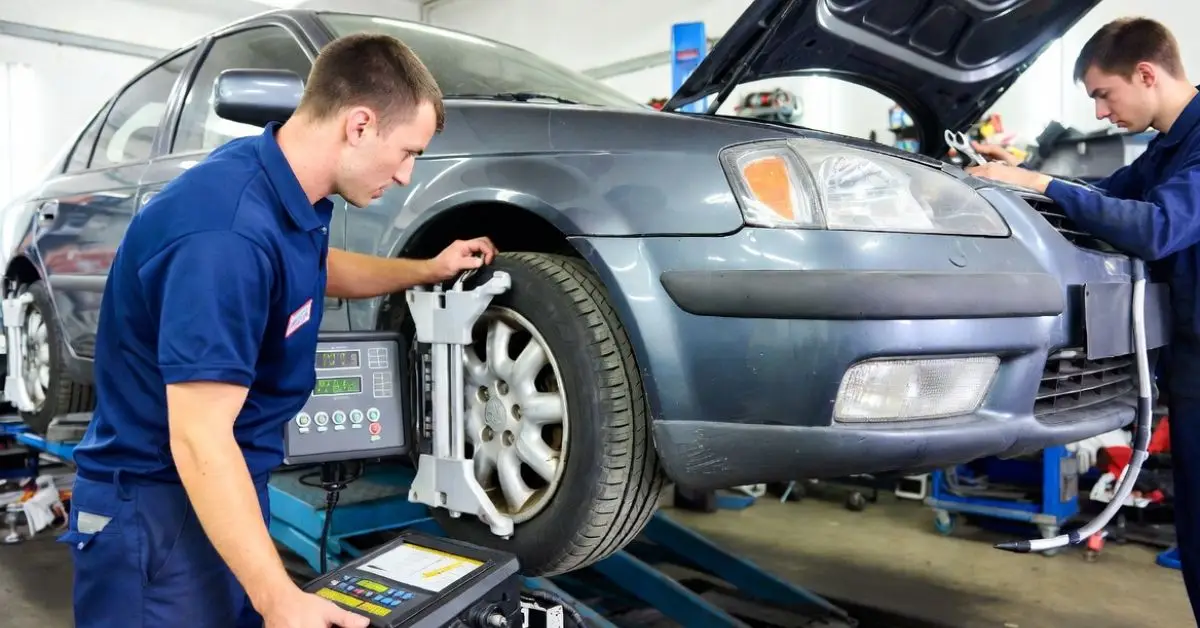
Wheel alignment is one of the most important services that is supposed to be done to your car, but not every driver understands what it is and what it does. When spoken simply, wheel alignment is the process of aligning your wheels to what is required in the manufacturer’s specification. Such angles are toe, camber, and caster, which define how your tires touch the road, how your car drives straight, and how your tires wear out. With the right alignment of your wheels, your car will run smoothly, your tires will wear longer, and you will also get good fuel economy.
The proper wheel alignment service makes sure that all four wheels are correctly adjusted relative to one another and to the car frame. There are three broad categories of alignment, and they are front-end alignment, rear-end alignment, and 4-wheel alignment. Front-end adjustment alters the front wheels only, the rear-end adjustment focuses mostly on the rear wheels, and the 4-wheel alignment alters all the wheels so that they are as stable and as precise as possible. This is highly essential in trucks, SUVs, and other automobiles that have a lift kit, as the vehicle is lifted and the angles of the suspension are changed, which can disrupt the alignment, thus leading to uneven wear of tires and also to handling problems.
Among the symptoms that may lead to the realization that your car needs a wheel alignment are: pulling to one side, poor tires, a steering wheel that is not at the center, plus the car being rough and unstable to ride. Research on the automotive industry indicated that well-aligned wheels would add up to 30 per cent to the life of tires, and offer up to 10 per cent or more in fuel efficiency. It is not only the comfort, but also the safety, and avoiding expensive tire changes, as well as sparing your suspension and steering parts from needless wear and tear. And whether you commute to work every day, or you take your off-road vehicle, you make sure your car is doing its job with a professional wheel alignment.
What Is Steering Alignment?
The term steering alignment is one that leaves numerous car owners puzzled, and that is the case because it is no different from wheel alignment. When individuals mention that their vehicle is drifting off course, it is because their steering wheel is deformed or their car is heading towards a specific course. In fact, what is being discussed is most often a problem of the steering geometry, or even the suspension components, or an off-balance wheel adjustment. Steering alignment is, however, not about a specific adjustment but rather about the way your steering wheel is in regard to your tires.
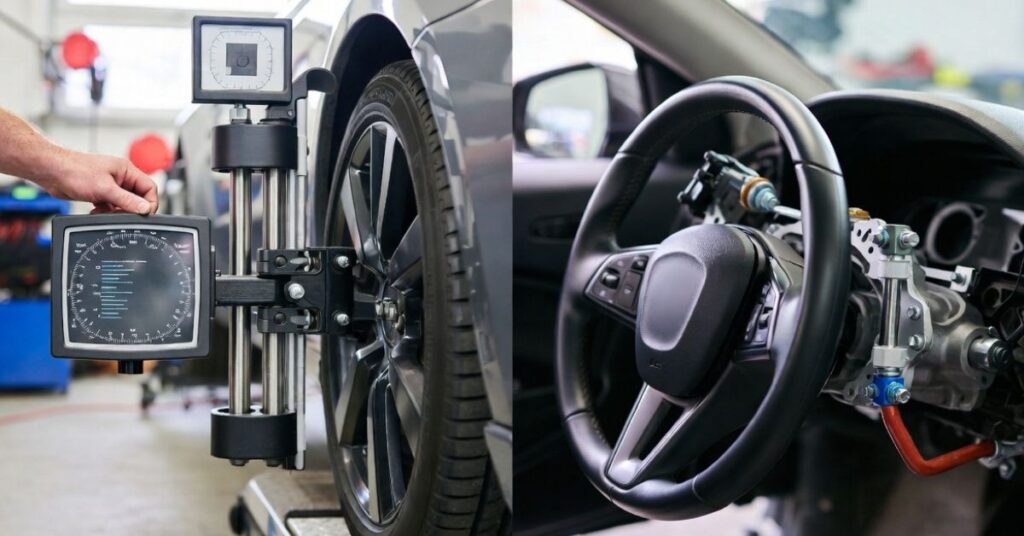
The steering system of your car consists of the steering wheel, the steering column, the rack-and-pinion or the steering box, and the linkages. When even one of these parts is slightly off-adjusted, then it might cause your steering wheel to feel off-center, loose, or hard to control. These problems are often observed in a normal wheel alignment, which involves the repair of the steering angle sensor and other suspension components by the technicians. To give an example, when a lifted truck has a new suspension that is installed, but the steering wheel is crooked, a typical remedy is to change the angles of the alignment, and not to do a separate steering alignment.
A steering alignment is commonly ordered when the operator experiences the presence of something being wrong with the steering wheel,e.g., the swivel ring is not straight when moving, the steering wheel is highly loose, or the turning does not respond. The solutions to these issues usually entail adjusting the wheel angles (toe, camber, caster), ensuring tie rod check, and changing the steering linkage. It is now understood that Wheel Alignment vs Steering Alignment is not a service that can be performed independently of it; this has close connections with precise wheel alignment. With the case of lifted cars, off-road trucks, or cars with upgraded suspensions, the issues are sorted out over time to have a smooth handling car, safe driving, and long life of tires.
Also Explore: Does Wheel Alignment Affect Steering? Find Out Why!
Wheel Alignment vs Steering: Key Differences
Most motorists mix up steering and wheel alignment since the symptoms may be similar. Both of them influence the way your car drives, yet there are significant differences to be aware of, mainly because you do not want to waste money repairing your vehicle, extending the life of its tires, and having your car experience improved handling. In simple terms, we should deconstruct the major differences.
- Purpose: The positioning of the wheels (toe, camber, caster, etc.) to match the specifications of the manufacturer is also a fine-tuning action. The main objective of it is to ensure your tires are in contact with the road adequately and hence your car is straight, your tires are symmetric, and your fuel efficiency is maximized. Steering alignment, conversely, is more of an impression of adjustment. Whenever people turn off center, or they feel that everything is not right with the steering wheel, what they need is either steering wheel alignment or inspection of the steering and suspension system. Also, steering alignment is not a service that is isolated.
- Symptoms: The symptoms of each may be similar, but there are some minor differences. In case of poor wheel alignment, you may observe uneven wear on tires, pulling away the car towards one side, vibration when driving at high speed, and low fuel efficiency. The steering alignment complaints are normally the steering wheel turning when straight, the steering wheel has an odd play, or the inability to maintain the vehicle in the center. Although the two of them need professional inspection, most of the problems that are leveled towards steering alignment can be resolved by proper wheel alignment.
- Service Process: Wheel alignment is a technique service and is a technical process undertaken with computerized devices that ensure the inspection of all four wheels and subsequent adjustment of the angles. Technicians realign toe, camber, and caster, occasionally checking the steering angle sensor. On the other hand, steering alignment is not done independently. When a mechanic is talking of steering alignment, he is either adjusting the steering wheel after the wheel alignment or checking the steering and suspension parts to find out whether they have parts that are worn out.
- Type of Vehicle and Upgrades: The distinction is even more paramount in the case of the lifted truck, SUV, and off-road cars. The angles of the wheels and steering geometry can be changed with suspension modifications and lift kits, and it means that a proper wheel alignment would be required to fix the wheel and steering issues. Neglecting this may cause steering wheels that are crooked, tires that are not even, and greater wear to the suspension parts.
When you have this knowledge, it becomes obvious why wheel alignment vs steering alignment is not only a matter of terminology but a matter of knowing what service will actually fix the issue and keep your car safe, efficient, and comfortable on the road.
Read About: Difference Between Wheel Alignment and Wheel Balancing Guide
Signs Your Vehicle Needs Wheel Alignment
Although you may not be aware that your car requires wheel alignment, there are some indications that you can identify whenever it is time to check your wheels. All these are what you need to know at an early age to prevent untimely wear on tires, handling problems, and high costs of repairs in the future. Most frequent indications that your car is in need of a wheel alignment are the following:
Car Pulls to One Side
A typical sign of improper wheel alignment when you are driving straight but your car pulls or drifts towards the left or right is another sign of improper wheel alignment. This is experienced when either or both wheels are inclined the wrong way, leading to unequal contact with the road. Overlooking this may result in the accelerated wear of tires on a single side and the fuel economy.
Crooked Steering Wheel
The other indicator of a car with a defective steering wheel is when the steering wheel does not center during a straight, linear drive. Though one may think that this would mean that the steering alignment needs to be done, this is usually a pointer that the wheel or the suspension is not in line. The steering wheel will also be corrected in most instances by undertaking wheel adjustment.
Uneven or Rapid Tire Wear
As you find that the tread is being worn off disproportionately, i.e., on one side more than on the other, or with the tires in a condition of wear that is faster than usual, you know that all is not going on well. With a proper alignment of the tires, tires wear at the same speed, which increases their life.
Vibration in the Steering Wheel
The steering wheel vibration at high velocities may also be one of the signs that the steering wheel is not in the appropriate place. Simple vibrations may also be caused by an unbalanced tire, yet the imbalance issues are likely to increase over time, and this is what happens to your body and control.
Poor Handling or Off-Center Feel
When the car feels unstable, wanders on the road, or does not react correctly when turning, it may be due to improper wheel angles. When well-aligned, the handling is correct, and driving stability is enhanced.
These misalignments may be more prevalent in the case of lifted trucks, SUVs, and off-road vehicles, and it is specifically necessary to notice them in their initial stages because, in this scenario, the suspension may be altered. The constant alignment of the wheels, which improves the safety of driving, also prevents your tires and steering components from any undue wear.
Read More About: Camber Alignment vs Wheel Alignment: Which One Do You Need?
How Often Should You Get a Wheel Alignment?

Wheel alignment is an essential procedure with respect to your tires, their lives, and the safety of your car. Another step that has been recommended by most professionals is the replacement of the wheels by means of wheel alignment at least once every 12,000 to 15,000 miles or once 1 year, whichever comes first. The frequency can, however, vary according to your driving conditions. Being driven on uneven roads, striking potholes too much, or on off-road (especially with lifted trucks or SUVs) in specific situations can cause your alignment to be checked more often. Season changes, such as ice roads, snow roads, or salt roads during the winter season, can also affect the wheel angles in the long run.
One can also consider it a nice idea to check your alignment after every major adjustment to your suspension or after replacing any tires or a lift kit. When the steering wheel is crooked, tires are irregularly worn, or when the car is pulled towards a specific direction, all these present an indication that the car should be checked for its alignment. Regular services not only ensure a smooth feel and optimum fuel efficiency, but also help in lengthening the life of your tires and in protecting the unnecessary wear and tear of the steering and suspension components. There are simple check-ups of the alignment that would save bigger and more costly long-term repairs.
Read More: How Often to Get Wheel Alignment to Protect Your Tires
Can a Bad Alignment Damage Steering Components Over Time?
It is not only imperative that all car owners, regardless of the mode of material, whether a normal car, an SUV, or an elevated off-road truck, must know the distinction between wheel alignment and steering alignment. Unlike wheel alignment, which is a precise procedure of trying to keep your wheels straight with the intention of ensuring that the road is being contacted correctly, steering alignment is simply a term people use when the steering wheel does not seem straight. Many steering issues can just be addressed by alignment of the steering wheels and the steering and suspension system.
Frequent wheel alignment not only enhances the handling and comfort of driving but also lowers the life of tires, increases fuel efficiency, and saves steering and suspension system parts from unnecessary wear. Cars that have either lift kits or enhanced suspensions require more frequent alignment checks because the changed geometry may soon bring about crooked steering wheels, uneven tires, and ineffective stability.
Knowing the main distinctions, clues of the lack of organization, and the necessity to check your vehicle timely, you will be able to stay safe, efficient, and comfortable on the road. They have to trust a professional alignment service like Gresham 4 Wheel Drive to guarantee that you have both tires and the steering system working at its best to guarantee your driving with ease and confidence.
Conclusion: Wheel Alignment vs Steering Alignment
Wheel alignment vs steering alignment is a concept that is vital to all car owners, not only those who drive ordinary vehicles, but also SUVs and lifted off-road vehicles. Whereas wheel alignment is a technical process in which you align the angle of your wheels to the road to make sure that they are touching the road, steering alignment is simply a phrase that people tend to use when their steering wheel does not seem to be centered. The majority of steering problems could be addressed with the help of the appropriate wheel adjustment, along with the inspection of the steering and suspension parts.
The routine checkup of aligning the wheels also ensures better handling and comfort in driving, as well as helps to increase the life of tires, increase fuel efficiency, and avoid unnecessary wear on steering and suspension components. Cars on a lift kit or upgraded suspension should also have an alignment check more often, since any change in geometry can easily lead to misaligned steering wheels, tires worn out of balance, and an unstable car. Knowing the most important distinctions, the indications of the misalignment, and the necessity of the check-ups in time, you are going to enjoy your vehicle and keep it safe and efficient on the road. The benefits of professional alignment services include the assurance that not only your steering system but also your tires are doing their job so that you always drive well and smoothly.