The short answer: Most tonneau covers can be removed in 25 to 45 minutes with basic hand tools. Soft roll-up and folding covers are the quickest and easiest. Retractable and hard one-piece covers take a bit longer and may need a second person. Hinged covers have their own removal process that’s different from all the others.
If you own a pickup truck, having a tonneau cover is a huge help. It keeps your cargo safe, protects your truck bed from dust and rain, and even improves fuel efficiency. But at some point you’ll still need to take it off to replace it, clean your truck bed, or fit accessories like a lift kit.
Tonneau covers are available in various styles soft roll-up, folding, retractable, and hard one-piece covers. All types of them have their own means of removal, and attempting to remove any of them without the appropriate knowledge will only end up breaking your bed rails or clamps. This is the reason why it is important to study the process before you begin.
Seasonal maintenance may be easier by removing the tonneau cover. Others remove soft covers when they are away in winter so as to avoid snow damage or retractable covers so as to clean the drainage channels. Even when you are about to do a wheel alignment or a bed adjustment, you can safely remove things to make sure that your truck is in good condition.
This guide walks through how to remove tonneau cover step-by-step, the tools you’ll need, and the mistakes to avoid so you can handle your truck bed cover safely and quickly. Gresham 4 Wheel Drive is the place that offers professional consultancy regarding all your pickup upgrades and a range of services.
Why You Might Need to Remove a Tonneau Cover
A truck owner may be forced to take off a tonneau cover for several reasons. One of the reasons is the change to a new cover. With time, soft roll-up or folding covers may fade away, deteriorate, or leak. By taking off the old truck bed cover, you can fit a new one, be it a retractable tonneau or a hard single cover, which is better protecting and even more appealing.
The other cause is to reach the truck bed to repair or upgrade. The cover has to be removed to install a lift kit, to align the wheels, or to fit taller cargo. This way will provide you with more room to work safely and avoid damaging the bed rails, clamps, or the cover itself.
Removal can also be occasioned by seasonal changes. Soft covers can be removed during winter to avoid snow or water damage, whereas retractable covers can be removed during summer to be easier to clean. This is done by removing the cover too to provide better ventilation when carrying sensitive goods such as plants or equipment.
Finally, the cover-off makes the process easier when maintaining and cleaning. The rails of retractable and folding covers can accumulate dirt, dust, or debris. Removing the cover will allow you to clean the bed, lubricate the rails, and inspect clamps or seals. Understanding how to remove tonneau cover correctly will ensure that your truck remains secure in the best condition.
What You Should Know Before You Remove a Tonneau Cover
The first thing to know before removing a tonneau cover is which type you have.verings have two or three panels and curve towards the cab. Fold the panels and ensure that the tailgate is rolled completely open. Through the socket wrench, loosen the clamps or bolts of the bed rails. After the panels are free, straight out of the truck bed The various types of roll-up, folding, retractable covers, as well as hard one-piece covers, have varying ways of removal. Knowing your type of cover would prevent the breaking down of the rails, clamps, or tailgate when removing it.
Then inspect your truck bed rail. The majority of covers are held in place with clamps or bolts, and the majority of the retractable covers are locked or drained. Checking the rail system will first guarantee that you are aware of which fasteners to take off and will avoid any complications when uncovering the cover.
Tailgate position is also important. Numerous covers are stretched over the tailgate, and in case the tailgate is not tightly closed or even not in place, there is a risk that you might scratch your truck or even bend the cover. The instructions are always to be followed to prevent any form of damage.
Finally, think about safety. Hard one-piece and retractable covers are bulky, and it is best to hire the help of someone or to put on gloves. It will make you take off your truck bed covers easier, safer, and stress-free, just because you prepared in advance and knew about these points.
Also Know About: Topper vs Tonneau Cover: Find Out Which Is Worth It
How to Identify Your Tonneau Cover Type
Before you touch a single bolt, figure out which cover you have; the removal steps depend on it. Here’s a quick guide:
| What you see | Cover type | What to check before removal |
|---|---|---|
| Fabric/vinyl cover that rolls toward the cab | Soft roll-up | Rear latch, side-rail clamps |
| 2–3 fabric panels that fold | Soft folding (tri-fold) | Front & rear clamps, straps |
| 2–3 rigid panels with hinges | Hard folding | Clamps, prop rods, panel weight |
| One solid lid on hinges | Hinged/one-piece hard | Hinges, mounting brackets, gas strut |
| Slats that slide into a box near the cab | Retractable | Canister, rails, drain tubes |
| Has a switch, motor, or wiring | Electric / powered | Power connection, manual release |
Tools You’ll Need to Remove a Tonneau Cover
Most removals need only basic hand tools:
- Socket wrench/ratchet set (usually 10mm or 12mm)
- Flathead and Phillips screwdrivers
- Allen wrench/hex key (some clamps)
- Work gloves
- A blanket, foam pad, or cardboard to rest the cover on
- A labeled bag or container for bolts and clamps
- A helper for hard, retractable, hinged, or electric covers
Some covers use tool-free quick-release clamps; check your mounting system first. If any part won’t release normally, stop and check the manual rather than forcing it.
How to Remove Tonneau Cover (Step-by-Step for All Types)
It might not be very easy to remove a tonneau cover, but with the correct method, it is easy. The knowledge of removing the tonneau cover in the right way will secure your truck bed, the cover itself, and your tailgate. Depending on the type of cover (soft roll-up, folding, retractable, and hard one-piece), slightly different steps are required, which is why we will prefer to divide it into definite steps. These recommendations will ensure that the process is safe and non-damaging at any time.
1. Removing a Soft Roll-Up Tonneau Cover
The simplest type of cover to take down is soft roll-up covers. Begin by unloading the tailgate clamps on each side of the truck bed. Close the cover fully down to the cab, and then take it out. Make sure none of the hooks, snaps, or Velcro are still attached along the bed rails. Soft covers are easy to carry around and therefore you can pretty much be able to manage the cover alone, but it is always convenient to have an extra pair of hands.
2. Removing a Folding Tonneau Cover
Folding covers have two or three rigid panels that fold toward the cab. Open the tailgate fully, then fold the panels forward. Use a socket wrench to loosen the clamps or bolts on the bed rails. Once the panels are free, lift the cover straight out of the truck bed. Take care of the hinges and do not force them to bend the cover. The coverings are also heavier than the soft roll-ups, and thus may require a helper.
3. Removing a Retractable Tonneau Cover
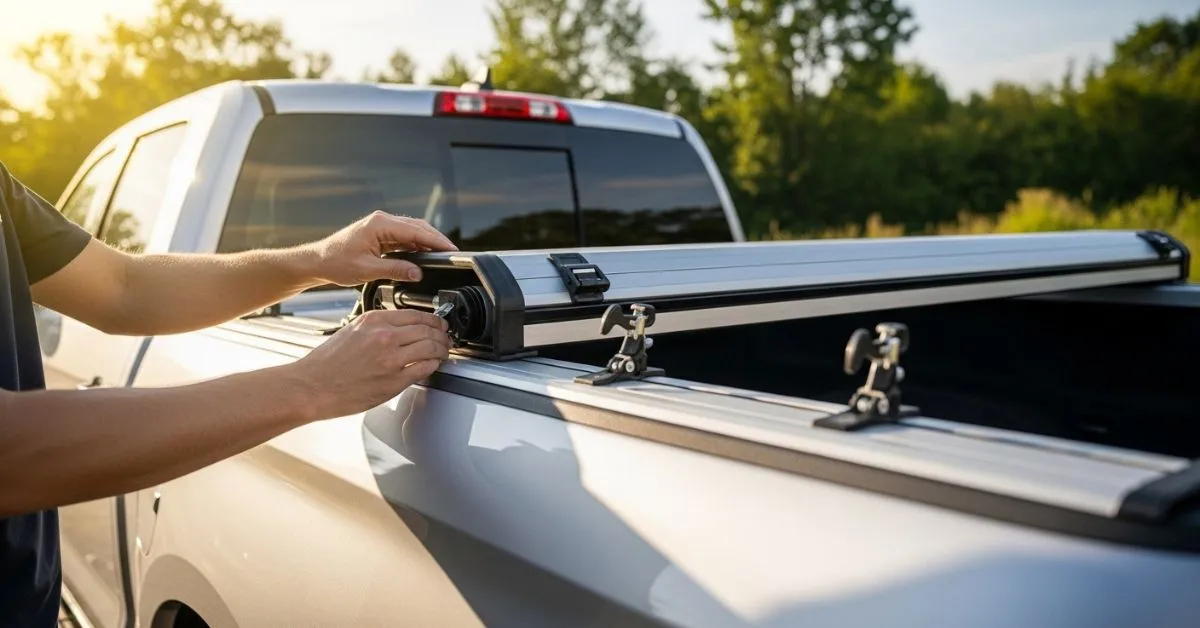
Retractable covers slide along the bed rails into a canister near the cab. Start by unlocking the tailgate-side latches. Loosen the bolts on each side rail, then gently slide the cover forward until it’s free of the rails. Look at the built-in drainage channels, which should not be forgotten; otherwise, they can be damaged or leak. Retractable covers may weigh moderately, and therefore, one must work slowly and ensure that one’s hands do not get caught.
4. Removing a One-Piece Hard Tonneau Cover
Hard one-piece covers are the heaviest and usually take two people to lift safely. To start with, open the tailgate and take off the mounting bolts on the rails. Carefully raise the cover straight up, but do not scratch the bed or tailgate. Put the cover on a padded surface to avoid damage. Gloves are also advised to hold on tight and prevent injury to the hands when taking them off.
5. Removing a Hinged Tonneau Cover
Hinged tonneau covers, also called flip-up or tilt-up covers, are hard panels that attach permanently to the bed rails with mounting brackets and open upward on a hinge, similar to a trunk lid. They’re common on trucks like the Ram 1500, Chevy Silverado, and Ford F-150 and are among the most secure cover types available. Removing them completely (not just opening them) requires a few extra steps compared to other hard covers.
Start by opening the cover fully to its upright position. Most hinged covers have a prop rod or gas strut that holds them open. With the cover propped open, locate the mounting brackets on each side of the bed rail. These are typically secured with bolts or T-bolt clamps. Using a socket wrench, loosen and remove the bolts from both sides, starting with the rear brackets and working toward the front.
With all brackets loosened, have a second person support the cover while you remove the final bolts. Hinged covers are heavier than they look, attempting solo removal risks dropping the cover onto your bed or tailgate. Carefully lift the cover straight up and set it on a padded surface to avoid scratching the finish.
Important: Before removing a hinged cover on a Ram 1500 or Silverado, check whether your cover uses factory-integrated bed rail seals. On some truck models, the tonneau rail seal is shared with the cover mounting bracket. Removing the cover incorrectly can damage the seal. Consult your cover’s installation manual or a professional if you’re unsure.
6. Removing an Electric (Powered) Tonneau Cover
Electric covers are the most complex to remove because they add wiring, a control module, and often drain tubes on top of the usual rails and canister. Work slowly and don’t disconnect anything you’re unsure about.
Start by opening the cover fully into its canister using the switch, then disconnect the vehicle battery or the cover’s power connection to avoid shorts. Locate and detach the wiring harness and any control module connectors take a photo first so you know how they route back. Check the drain tubes near the cab and detach them carefully. Finally, loosen the rail bolts and lift the canister and rails off with a second person.
If the cover is powered, stuck, or has no clear manual-release procedure, this is the point to call an installer forcing a powered cover can damage the motor or wiring.
After taking the tonneau cover off, check the rails, clamps, and tailgate to see whether they are dirty or not. Wipe and grease the rails where necessary and put the cover in a secure and cushioned place. The ability to take off the tonneau cover correctly not only keeps your truck safe but also ensures that your cover remains in good condition to be used in the future. When it has been handled with care and the right steps, you will be free to access your truck bed to the fullest and be at peace.
Also Explore: How to Install a Hard Tonneau Cover Like a Pro
How to Remove Tonneau Cover Rails and Clips
Removing the rails and clips is a separate step from removing the cover itself, and it’s one of the most commonly asked about parts of the process. Most truck owners only need to remove the cover panel, but if you’re doing a full teardown for deep cleaning, bed liner installation, or switching to a completely different cover system, the rails need to come off too.
Tools needed: Socket wrench (typically 10mm or 12mm), flathead screwdriver, and a clean cloth to protect the bed rail finish.
Step-by-step rail removal: Start by removing the cover panel first, using the steps for your cover type. Rails should always come off after the cover, not before. With the cover removed, locate the clamps or T-bolts securing the rails to the bed. On most covers, these are spaced every 12 to 18 inches along the rail length there are typically 3 to 5 clamps per side.
Loosen each clamp bolt with your socket wrench do not remove them completely yet. Once all clamps on one side are loosened, slide the rail toward the tailgate to disengage it from the front mounting point, then lift it out. Repeat on the other side.
Clips: Most rail systems use plastic end caps and alignment clips that snap into the bed rail channel. These can be pried out carefully with a flathead screwdriver go slowly to avoid cracking the plastic. If a clip is stuck or brittle, apply a small amount of silicone lubricant and wait a few minutes before trying again.
After removal: Wipe down the bed rail channel and inspect for rust, debris, or damaged seals before reinstalling. This is also the best time to clean drainage channels on retractable cover rail systems. A buildup of debris here is the most common cause of water leaks around the cover seal.
Which Tonneau Cover Is Easiest to Remove?
If you take your cover off often, some types are far less hassle than others:
| Cover type | Ease of removal | Trade-off |
|---|---|---|
| Soft roll-up | Easiest; often one person, few clamps | Less rigid, less secure |
| Soft folding (tri-fold) | Easy | Blocks part of the bed when folded |
| Hard folding | Moderately heavier panels | More weight to handle |
| Hinged/one-piece hard | Hardest, bulky, needs two people | Most secure |
| Retractable | Moderate; more parts to inspect | Canister & drain tubes |
| Electric | Hardest wiring involved | Most complex |
Bottom line: if frequent removal matters to you, a soft roll-up or folding cover with quick-release clamps is the easiest to live with. If security is the priority, a hinged or retractable cover is worth the extra effort.
Common Mistakes When Removing a Tonneau Cover
Although a tonneau cover may be easy to take off, most truck owners tend to make mistakes, which may end up destroying the tonneau cover itself, truck bed rails, and even the tailgate. The correct way of taking the tonneau cover off can also save you from all these traps. These are the most common mistakes and the ways to avoid them, which keep your truck in the best condition.
- Stripping Bolts or Clamps: The most frequent mistake is that, in unscrewing a bolt or a clamp, a very large amount of force is applied. The fasteners may be stripped in case they are operated with the wrong-sized wrench or screwdriver. Unscrewed bolts are more difficult to remove and might need to be replaced. Especially, always take your time with every bolt or clamp using the correct tools.
- Damaging the Bed Rails: The bed rail can be bent or scratched by pulling or twisting the cover too hard. Other covers are fastened using lightweight clamps or brackets, which have to be loosened with caution. Do not press the cover down; ensure that the clamps are completely loose, and then lift. Secure your rails on the bed to maintain the new look of your pickup.
- Forgetting Tailgate Clearance: A lot of truck owners fail to look at the position of the tailgate before uncovering the cover. When the tailgate is not completely closed or placed in the correct position, the cover may scratch or dent the tailgate. Always use the tailgate positioning instructions of the manufacturer. This is a mere trick that will not provide scratches and will maintain the cover in line.
- Removing Heavy Covers Alone: Hard one-piece or retractable covers are surprisingly heavy. It might hurt you or drop the cover and ruin it and your truck in the process of trying to remove them on your own. Never work without support or help. Gloves also enhance grip and minimize the chances of slipping when handling heavy covers.
- Ignoring Rails and Drainage Maintenance: There are some owners who strip off the cover without inspecting the bed rails and drainage passages. Long-term damage can be done by dirt, debris, or rust in these areas. Inspect, clean, and lubricate the rails always before replacing or storing the cover. This would guarantee a trouble-free operation, and it would also help in making your tonneau last longer.
- Removing a Hinged or Hard Cover Without Propping It First: Many truck owners try to remove the mounting bolts on a hinged cover while holding the cover up with one hand. This is how covers get dropped, and tailgates get dented. Always use the built-in prop rod or gas strut to hold the cover open before touching any bolts. If your prop rod is broken or missing, have a second person hold the cover before you begin loosening any fasteners.
Explore More: How Much Does a Tonneau Cover Cost in 2026?
When to Get Professional Help
Though in most cases, a tonneau cover can be removed by the owner of a truck, certain conditions require professional help. The knowledge of how to remove tonneau cover is good, but strong, hard tonneau covers or retractable ones may pose some difficulty and may need an additional pair of hands or a special tool so as not to cause an injury or damage.
Making modifications to trucks is also suggested by professional assistance. Installation of a lift kit, suspension adjustment, or wheel alignment can cause interference with tonneau rails. Professionals are able to take off the cover without creating any damage to other sections of your truck bed, leaving everything in good condition.
Another reason to call a professional is old, stuck, and damaged covers. This may cause stripping of bolts, bending of the rail, or scratches on the bed when trying to perform a DIY removal. The services that can be trusted, such as Gresham 4 Wheel Drive, are able to take these covers off in a safe manner and install your bed to upgrade or get a new cover.
Lastly, even with light covers, it might be best to have someone assist and save time and frustration. Professionals understand how to deal with covers effectively, defend their truck, and avoid injuries. With professional assistance, your pickup will be safe, operational, and prepared to use any accessory or upgrade.
Conclusion
Removing a tonneau cover is a manageable job once you know your cover type and follow the right steps. Whether you’re switching to a new cover, cleaning the truck bed, or making room for accessories like a lift kit, careful removal protects both your truck bed and the cover itself. Identify your cover type, inspect the bed rails, use the correct tools, and get a second person for heavier hard, retractable, or hinged covers; that’s really all it takes to do it safely.
If a cover is old, stuck, or damaged, or you’d simply rather not risk scratching your bed, it’s worth calling a professional. At Gresham 4 Wheel Drive, we remove heavy, stuck, or complex covers safely and can handle any replacement or truck bed upgrade at the same time, leaving your truck ready to go.
📞 Call us at 503-400-7646, or stop by for a free estimate on cover removal, installation, or any truck bed upgrade.
Frequently Asked Questions
Q1: Can I remove a tonneau cover by myself?
Ans: Yes, most soft roll-up and folding covers can be removed by one person. Hard one-piece, retractable, hinged, and electric covers are heavier and safer to remove with a second person.
Q2: Do I need tools to remove a tonneau cover?
Ans: Usually just a socket wrench (10mm or 12mm) and a screwdriver. Some covers use tool-free quick-release clamps. Always check your mounting system before starting.
Q3: How do I remove a hard tonneau cover?
Ans: Open or fold it as designed, loosen the mounting clamps or bolts evenly on both sides, and lift it straight up with a helper. Never drag a hard cover across the bed rails or tailgate.
Q3: How do I remove a soft roll-up tonneau cover?
Ans: Release the rear latch, roll the cover toward the cab, and loosen the side-rail clamps. Soft covers are light enough for one person in most cases.
Q4: Can removing a tonneau cover damage my truck?
Ans: It can if hardware is forced, drain tubes or wiring are overlooked, or a heavy cover is lifted without support. Done correctly right tools, even pressure, a helper for heavy covers the risk is low.
Q5: How do I remove a tonneau cover on a Ram 1500?
Ans: The Ram 1500 uses many hinged and folding covers. Prop the cover open first, then remove the bracket bolts from rear to front. On some Ram 1500 and Silverado models the rail seal is shared with the mounting bracket; remove it carefully or check your manual to avoid damaging the seal.